
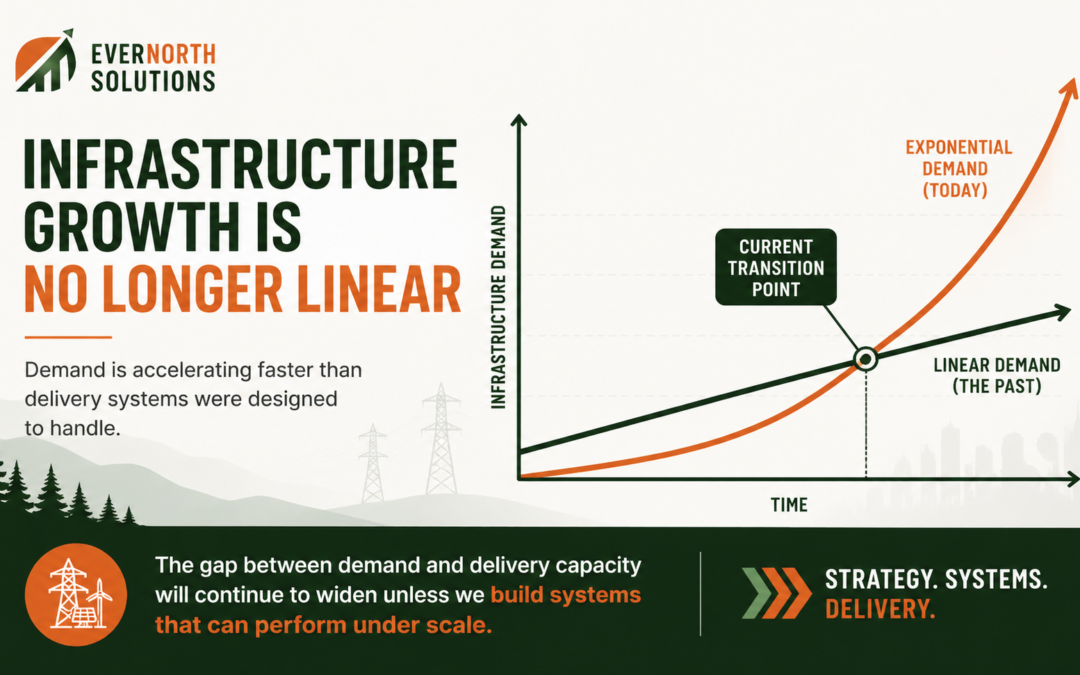
Utilities didn’t plan for exponential growth—because it didn’t exist before.
For decades, infrastructure demand followed a relatively predictable path. Growth was steady, largely linear, and aligned with population increases and incremental economic expansion. Delivery systems evolved to match this environment, optimized for consistency, control, and repeatability. The way projects were planned, staffed, and executed reflected those conditions.
That model worked but the conditions that supported it no longer exist.
Today, utilities are facing a convergence of forces that are reshaping infrastructure demand in ways that are difficult to compare to the past. Electrification of transportation and industry is increasing load requirements at a pace few anticipated. Data centers are expanding rapidly, creating concentrated demand in specific regions. At the same time, aging infrastructure requires modernization, while resilience investments are becoming more urgent in response to climate-related disruptions.
Each of these forces would be meaningful on its own. Together, they are compounding, increasing both the volume and complexity of work moving through delivery systems.
The result is not incremental growth. It is accelerated scaling.
This shift changes more than the amount of infrastructure that needs to be delivered. It changes how delivery systems behave under pressure.
Most delivery systems in the utility industry were designed for a different set of conditions. They were built to manage predictable project volumes, moderate complexity, and relatively stable timelines. Processes and coordination models evolved within that context, and over time they became embedded in how organizations operate.
Under linear growth, inefficiencies could be absorbed without significant consequence.
Under accelerated scaling, those same inefficiencies become more visible and more consequential.
At first, the impact is manageable. Project volumes increase, timelines begin to compress, and teams adjust by reprioritizing work and adding resources where possible. Organizations respond in ways that have historically worked, and for a period of time, that response is sufficient.
But as demand continues to build, a different pattern begins to emerge as delivery systems begin to experience strain.
Coordination becomes more difficult as the number of active projects increases. Work that was once relatively contained begins to overlap, introducing dependencies that are harder to manage. A delay in one area begins to affect work elsewhere. Review cycles become more iterative as teams work to maintain quality under tighter timelines, and assumptions made early in projects are tested against changing conditions.
What was once manageable complexity begins to create friction across the system. This is not a failure of execution. It is a system responding to scale.
As pressure increases, small inefficiencies begin to compound. A coordination gap leads to redesign. A compressed timeline introduces risk that must be resolved later. A delay in one project creates ripple effects across others. These issues are familiar to most delivery teams, and in isolation they are often manageable.
At scale, they begin to interact.
The result is a gradual reduction in delivery efficiency. Projects take longer to complete, costs increase, and teams operate under sustained pressure to keep pace. Over time, the gap between the amount of work required and the system’s ability to deliver it effectively becomes more pronounced.
In response to this pressure, most organizations focus on expanding capacity. They hire more engineers, engage additional partners, and attempt to accelerate workflows. These actions are necessary, and in many cases they are the only immediate lever available. However, they are not always sufficient because the constraint is not only capacity. It is how the system performs under scale.
Adding resources into a system that is already under strain can increase complexity. More people and more parallel workstreams introduce additional coordination requirements. Without improved visibility and alignment, the likelihood of miscommunication and inefficiency increases. Over time, this can reduce the effectiveness of the additional capacity being added.
This creates a dynamic many organizations recognize. Despite increased investment and effort, delivery performance does not improve proportionally. In some cases, it becomes less predictable.
This is where many delivery systems begin to struggle.
More input does not automatically produce more output, particularly when inefficiencies are compounding across the system.
What makes this shift more challenging is that it is not temporary. The forces driving infrastructure demand are structural. Electrification, digital infrastructure expansion, and resilience investments are expected to persist for years, if not decades.
Utilities are not navigating a short-term surge. They are operating in a different environment. In this environment, the assumptions that guided delivery in the past are no longer sufficient. Systems designed for stability must now operate under sustained scaling conditions, where variability, complexity, and interdependence are higher than before.
This requires more than incremental adjustment. It requires a shift in how delivery is understood.
Infrastructure delivery has traditionally been managed at the project level. Each project is planned and executed largely on its own terms, with performance measured against its individual scope, schedule, and budget.
Under accelerated scaling, that perspective becomes limiting.
The performance of any single project is increasingly influenced by what is happening elsewhere in the system. Shared resources, overlapping timelines, and interdependent workstreams mean that issues are rarely isolated. They tend to propagate, often in ways that are not immediately visible.
To manage this effectively, delivery must be viewed as a system, not just a collection of projects. It is a system with constraints, dependencies, and behaviors that become more apparent under pressure.
When organizations begin to view delivery this way, different questions emerge. Attention shifts toward where friction accumulates, how delays spread, and why certain patterns repeat. This perspective makes it easier to identify where capacity is being lost, not because resources are unavailable, but because the system is not functioning as efficiently as it could.
The utilities that adapt most effectively will not necessarily be those with the largest teams or the highest levels of investment. They will be the ones that develop a clearer understanding of how their delivery systems behave under real conditions because they recognize that scaling delivery is not just about doing more work. It is about improving how work flows through the system. That includes identifying where inefficiencies accumulate, understanding how issues interact across projects, and creating the conditions for more coordinated and predictable delivery. It also requires making complexity visible earlier, so it can be managed rather than reacted to.
The transition from linear growth to accelerated demand marks a turning point for the industry. It exposes limitations that were previously less visible and challenges long-standing assumptions about how delivery systems operate.
Organizations that continue to operate as if growth is linear may find themselves in a constant state of reaction, adding resources, adjusting timelines, and managing issues as they arise.
Organizations that recognize the shift can take a different approach. They can focus on strengthening the system itself because in an environment defined by scale, system performance becomes a primary driver of delivery performance.
How is your organization adapting to exponential demand—not just higher volume? If you’re seeing signs of strain, it may be time to look at how your delivery system is performing under scale.
 English